Round or Canon: How One Tune Becomes an Ensemble
Round or canon: learn how repeating and rule-based entries differ, so you can choose a clear, satisfying arrangement for your singing group.
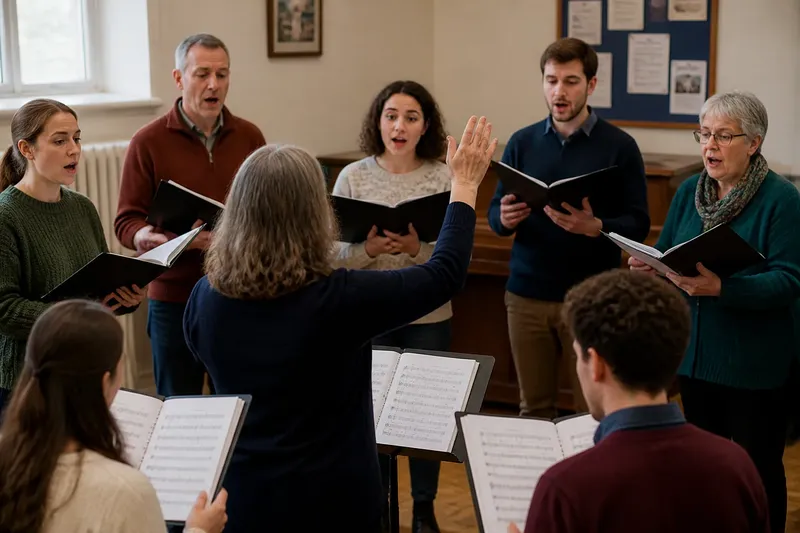
The common mistake with a round or canon is to teach the melody but leave the entry and ending unclear. The cost is a confused overlap: singers may know the tune yet not know when to begin, whether to repeat it or how to stop. In both forms, one musical line can be heard alongside another, but the parts do not always follow the same plan.
A round usually repeats one melody in a cycle
In a familiar round such as “Row, Row, Row Your Boat”, everyone learns the same melody. One group begins, and another enters at an agreed point while the first carries on. More groups can join in turn, each starting at the beginning of the tune while the others are further along.
In the usual singing-session sense, a round loops: each group returns to the start when it reaches the end, until a shared stopping cue. The precise use of round and canon can vary between everyday speech, scores and music teaching, so it is more helpful to check what the arrangement asks each part to do than to rely on the label alone.
For a group, the round’s practical feature is that everyone learns one line. Singers then need to hold their place while hearing the same melody begin elsewhere. A clear phrase ending or leader’s gesture can make the next entrance easier to follow.
A canon follows a rule that can shape the reply
In music theory, canon commonly describes a relationship in which one part follows another according to a stated musical rule. A follower might repeat the leader’s melody after a delay; it might also follow at a different pitch or use a particular change to the tune. Those changes are specific canon techniques, not features every canon must contain.
For instance, a canon at a different pitch keeps the follower recognisably related to the first line while placing it higher or lower. In an inversion, the intervals’ direction is turned around according to the piece’s rule. In augmentation, the notes are lengthened. These are distinct ways of organising a follower, and singers should use the written or taught part rather than improvise a change.
Many simple rounds are described as canons because one group follows another with the same tune. But labels are not used identically in every setting. For rehearsal, the useful question is concrete: does each part repeat the same line in a cycle, or does the score prescribe another relationship between the lines?
Listen for the entry, the rule and the ending
At the entrance, notice where the next singer starts: after a phrase, after a longer delay, or at another point marked by the leader. Then listen for what happens to the tune. Does it return unchanged at a different time, or does the follower use a specified pitch or rhythmic alteration?
The ending deserves equal attention. Some rounds continue until a leader signals the stop; an arranged piece may instead have a written final note or a set sequence. Agreeing on the cue before splitting into parts lets singers listen to one another without guessing when the music is finished.
What do singers often ask about rounds and canons?
Does a round always repeat from the beginning?
In the usual group-singing form, each part loops back to the start until the agreed ending cue. If a particular arrangement gives a different ending, follow its instructions rather than assuming the tune should keep cycling.
Is every canon a round?
Not necessarily: in common theory usage, a round is a familiar kind of canon in which the same melody enters successively and repeats. Because terminology varies, check the score or leader’s directions to see whether the parts loop or follow a different rule.
What does inversion mean in a canon?
In an inversion, the follower turns the direction of the melody’s intervals according to the composition’s rule. It is a particular technique, not a requirement for a canon, so singers should learn the written follower line rather than try to guess it from the leader.
How can a group stop a round together?
Agree whether everyone stops on a cue, finishes a cycle or holds a final note. A visible hand signal can help when the overlapping lines make spoken directions hard to hear.
Choose the arrangement that suits the rehearsal
A round is often a straightforward choice when the group wants one shared melody and staggered entries. Teach the tune together first, mark the entrance point, then have each group practise holding its own place as the other part begins.
A canon with a changed pitch, rhythm or other specified rule may need more separate rehearsal. A printed score can show the parts; a keyboard can provide starting notes, and a leader can sing each line alone before the group puts them together.
Say your group has learned the four short phrases of a made-up song, and you have time to rehearse its opening and ending. You divide the singers into two groups, cue the second group at the start of the third phrase, and agree to stop when you raise your hand after the next return to the tune’s first phrase. The expected result is a repeating overlap with an audible entry and a shared finish; if the second group cannot hold its place, keep the melody in unison and practise the cue before trying the overlap again.
- Check that everyone can sing the whole melody in unison; if not, then teach it phrase by phrase, or choose a simpler tune.
- Check that the entry point is marked at a clear phrase boundary; if not, then move the cue to a clear boundary, or have the leader demonstrate the exact entrance.
- Check that each group knows whether its line repeats; if it does, then agree on the stopping cue, or choose an arrangement with a written ending.
- Check whether a follower has altered pitches or note lengths; if it has, then rehearse that part separately, or select a version with the same melody in every group.
- Check that singers can hear the leader’s cue during the overlap; if they can, then use it to signal the ending, or agree on a visible hand signal.
- Check that the chosen number of entries remains clear to the group; if it does, then keep the arrangement, or use fewer groups and practise the entrances again.
Make the musical rule easy to hear
A useful way to teach the distinction is to think of a round as a paper strip joined into a ring: the same tune keeps coming round. A broader canon is more like a set of instructions for replying to a tune; the reply may repeat it, or follow a particular change. The analogy is only a starting point—the score or rehearsal plan tells singers exactly what to do.
When choosing a round or canon, focus on the parts, not just the name. Identify the entrance, the follower’s rule and the shared ending, then teach those details before adding the overlap. That gives the group a clear musical conversation to listen for.